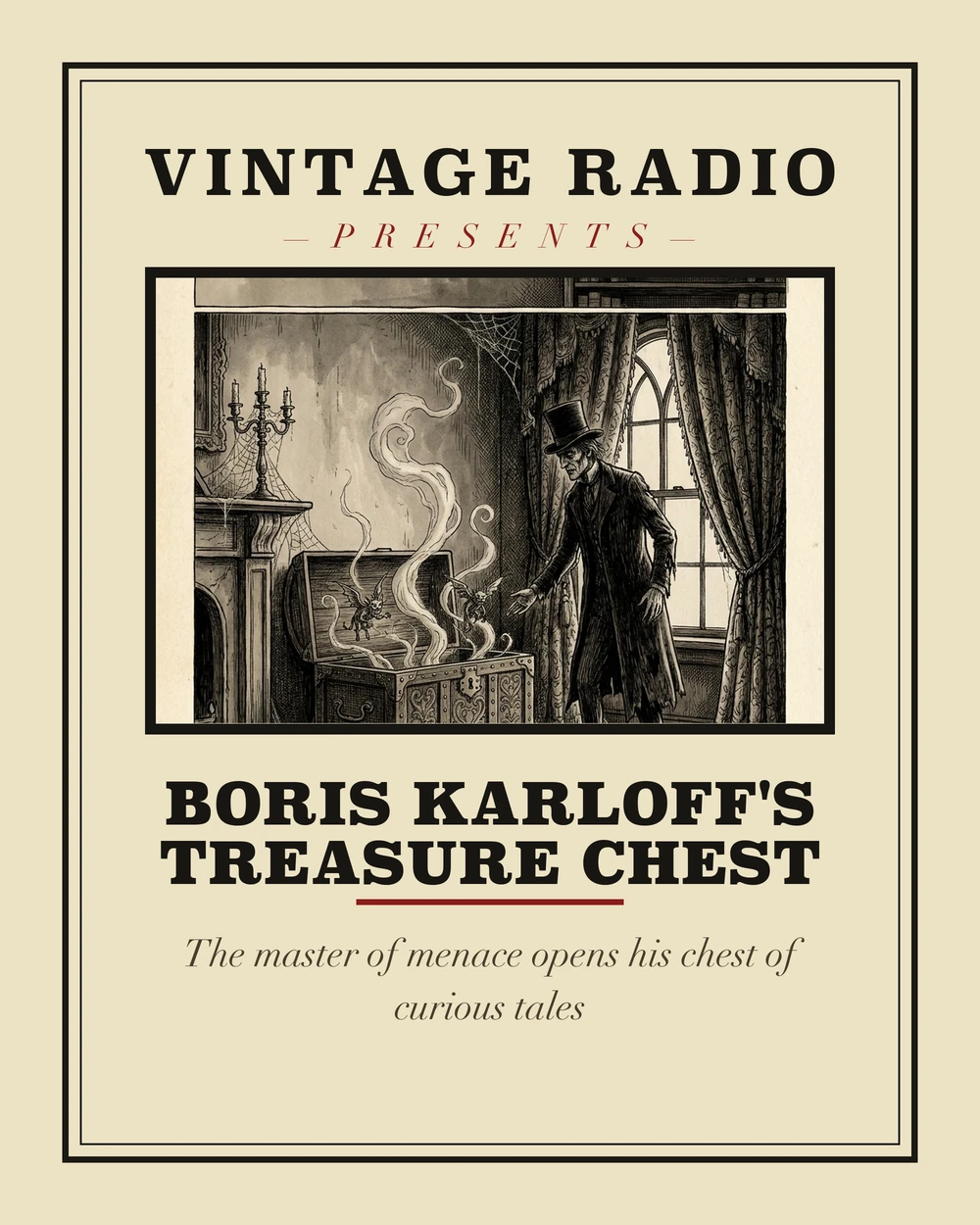
Boris Karloff's Treasure Chest
A Short Run With an Unusual Setup
Thirteen weeks, thirteen episodes, and four different titles. Boris Karloff's Treasure Chest began on September 21, 1949, broadcasting Wednesday nights at 9 on ABC radio, and somewhere along the way picked up the alternate names Presenting Boris Karloff, The Boris Karloff Mystery Playhouse, and Boris Karloff Presents. Beginning with the October 27 broadcast, the official title was changed to Mystery Playhouse Starring Boris Karloff — though by then the show was already half over.
What set it apart from most radio anthologies of the era wasn't Karloff's presence so much as the production setup. Identical versions of each episode aired on ABC television the following Thursday, with the same cast performing scripts that had been adapted for each medium. The television side was almost certainly produced live and captured via kinescope, the era's standard method of preserving a broadcast by filming a video monitor as the show went out. Producer-director Charles Warburton oversaw both halves of the operation, with organ accompaniment from George Henninger providing the atmospheric backbone radio anthologies of this kind relied on. Alex Segal directed on the television side, and the rotating casts included Mildred Natwick and Jean Muir.
What Karloff Brought to It
Karloff served as host and occasional star, the standard anthology arrangement — the host gave the show a consistent identity while stories and supporting casts rotated. His voice and his reputation did a lot of work. By 1949 he had spent nearly two decades building his association with horror and the uncanny, and a program with his name attached carried an implicit promise about tone. He'd been down this road before, hosting an eight-episode ABC revival of Lights Out in the summer of 1947 — a run cut short when sponsor Eversharp Pencils pulled out after three episodes over content objections.
The source material came from established writers. Adaptations drew on Cornell Woolrich, whose fiction leaned toward suspense and psychological tension, and Arch Oboler, who had made his own mark in radio with dark, unconventional material. The October 5 entry "Mungahara" was lifted directly from an Oboler script originally produced for Lights Out!, indicating the series drew on pre-existing radio scripts rather than commissioning entirely new work. The finale, "The Night Reveals," adapted a Woolrich story that had already been dramatized on Suspense with Robert Young and Margo — an insurance investigator coming to suspect his own wife is the arsonist behind a string of New York City fires.
The premiere, "Five Golden Guineas," gave Karloff one of his more memorable radio roles: an unscrupulous hangman who executes a young man he knows to be innocent, only to learn afterward that the condemned was his own son. Stephen King singled the episode out years later in Danse Macabre, comparing it to a later Thriller episode called "Guillotine" — one of the few critical references the series ever received.
Why It Ended When It Did
The show didn't outlast 1949, and no explanation for its cancellation survives in the record. Whether the run was always intended as a limited thirteen-week engagement or was cut off by poor reception isn't documented; no Nielsen data for the program has surfaced, and the season's surviving rating lists only cover the top ten — a tier the show never reached. The conceptual competition gives some sense of the landscape: Suspense ranked #8 nationally for 1949–1950, occupying exactly the territory Treasure Chest was trying to break into.
Short anthology runs were common during this transitional period. Networks were still sorting out what worked on the television side, and a program designed to serve both radio and TV at once was an experiment without a clear template. None of the episodes are known to survive — neither the radio broadcasts nor the kinescoped television versions. What remains is a compact body of work and an episode log: thirteen titles, three months, and a brief stretch when Boris Karloff was simultaneously a Wednesday-night radio host and a Thursday-night television presence, adapting quality fiction for audiences on both sides of the shift.